

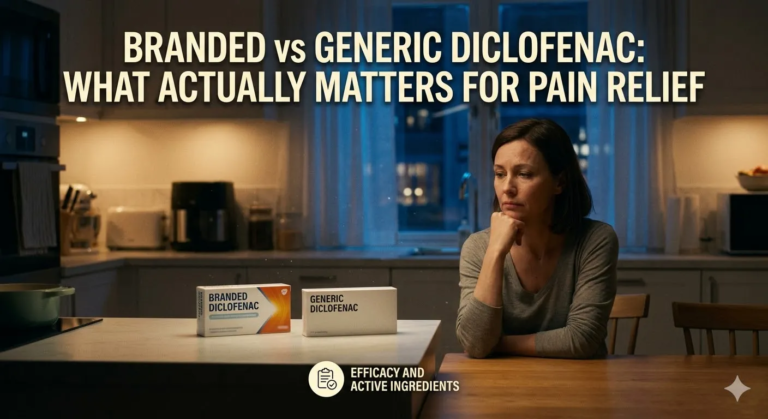
Introduction: The Pharmacy Aisle Dilemma
You’re standing in the pharmacy aisle, prescription in hand, staring at two nearly identical tubes of diclofenac gel. One is Voltaren Emulgel—the trusted name your doctor mentioned—priced at three times the cost of the store-brand alternative sitting inches away. Same active ingredient. Same concentration. But is it really the same medicine?
This isn’t just about saving money on arthritis cream. For chronic pain patients managing tight budgets alongside persistent inflammation, the branded versus generic decision carries real weight. The fear isn’t irrational: what if cheaper actually means less effective when you’re already dealing with limited relief options?
Here’s what makes this question more complex than most medication comparisons: diclofenac formulations involve more than just the active drug molecule. The delivery system—how that drug penetrates your skin and reaches inflamed tissue—varies between products. Quality control studies have found measurable differences in dissolution rates and drug release patterns among diclofenac products, even when they meet regulatory standards.
This article examines the science behind bioequivalence testing, breaks down what actually differs between branded and generic topical NSAIDs, and addresses whether those differences matter for your pain management. We’ll explore FDA approval processes, inactive ingredient impacts, and real-world cost-effectiveness—without pharmaceutical marketing spin or blanket dismissals.
The Science of Similarity: What Makes a Generic “Equivalent”?
The FDA doesn’t just rubber-stamp generic diclofenac products because they contain the same active ingredient. They undergo rigorous testing to prove bioequivalence—a clinical standard that ensures the generic performs virtually identically to the brand-name version in your body.
Research published by the National Institutes of Health demonstrates that approved generic NSAIDs must deliver the same therapeutic effect as their branded counterparts. The FDA requires that generics demonstrate their absorption rate and extent fall within 80–125% of the branded drug’s rate and extent. This is an acceptance criterion, not just a confidence interval. In practice, most generics cluster near the midpoint, meaning the actual difference is typically 3.5% or less.
For topical diclofenac specifically, bioequivalence studies measure how much medication penetrates the skin and reaches inflamed tissue. Clinical trials comparing generic diclofenac sodium topical gel to Voltaren evaluate both pharmacokinetic profiles (how the drug moves through tissue) and pharmacodynamic responses (actual pain relief outcomes). These head-to-head studies must demonstrate “no clinically meaningful difference” before FDA approval.
The bottom line: when a generic diclofenac gel receives FDA approval, it has already proven it delivers the same pain-relieving effect as Voltaren. Quality control studies consistently confirm that approved generics meet the same dissolution, content uniformity, and stability standards. The next question is: if they’re therapeutically identical, what actually separates them?
The Real Differences: Inactive Ingredients
When comparing Voltaren vs generic diclofenac formulations, the active pharmaceutical ingredient is biochemically identical—but the supporting cast of inactive ingredients (excipients) tells a more nuanced story. These “inactive” components aren’t medically inert. They control absorption rates, skin penetration, stability, and allergic responses.
Harvard Medical School researchers note that while generic drugs contain identical active ingredients, manufacturers may use different binders, fillers, and preservatives. For topical diclofenac gel, this means variations in emulsifiers like propylene glycol or preservatives like parabens.
Consider two common examples of how these differences show up in practice:
- Penetration enhancers: One formulation might use isopropyl alcohol; another relies on dimethyl sulfoxide. Both are effective, but they produce a different skin feel and drying time.
- Preservatives: Some generics use parabens; others use alternative preservatives. For most patients this makes no difference, but for those with documented sensitivities, it matters.
Comparative quality control studies consistently show that properly manufactured generics meet dissolution and uniformity standards regardless of excipient differences. However, patients with specific sensitivities should check the inactive ingredient list on any new formulation. You can find this on the package insert, the manufacturer’s website, or by asking your pharmacist directly.
Excipient differences exist, but they are clinically significant for a minority of patients with documented sensitivities—not the general population.
Price Comparison: The Cost of the Name Brand
The price gap between branded Voltaren and generic diclofenac represents the starkest difference most patients notice. Generics typically cost 70–85% less than branded alternatives. This pricing disparity stems from pharmaceutical economics, not product quality.
Brand-name manufacturers amortize research, clinical trial costs, and marketing budgets across their sales. Generic manufacturers bypass these expenditures entirely, entering the market once patents expire with products that required no discovery phase—only bioequivalence demonstration.
The Hidden Cost Variables
What complicates direct price comparison is the role of insurance coverage and pharmacy benefit managers. Some insurance plans preferentially cover branded Voltaren through manufacturer rebate agreements, paradoxically making the “expensive” option cheaper at the pharmacy counter for certain patients.
Conversely, many Medicare Part D and commercial plans impose step-therapy protocols requiring a generic trial before authorizing brand coverage. A Voltaren prescription might cost $15 with a manufacturer coupon while the generic requires a $30 copay—making the “premium” option financially smarter in that scenario.
Generic selection criteria involves more than bioequivalence verification—it includes stability assessments and dissolution testing that ensure therapeutic consistency. This regulatory rigor means cost savings don’t compromise clinical outcomes.
The financial calculation becomes personal when considering long-term arthritis management. Over months or years, the cumulative savings from generic diclofenac can fund other healthcare priorities—but only if the specific formulation works equivalently for your physiology.
When Should You Stick with the Name Brand?
Despite bioequivalence standards ensuring generic diclofenac gel matches branded formulations in therapeutic effect, specific clinical scenarios warrant considering name-brand products—though the reasons are often practical rather than pharmacological.
Formulation Consistency for Sensitive Patients
If you’ve achieved stable symptom control on Voltaren after experiencing skin irritation with a generic topical formulation, switching introduces unnecessary risk. The potential cost savings don’t offset destabilizing effective treatment. Excipient variations can affect tolerability in patients with multiple chemical sensitivities or documented allergies to specific inactive ingredients.
Insurance Formulary Design
Counterintuitively, certain prescription plans negotiate lower copays for specific name brands than their generic equivalents, particularly when manufacturer coupon programs are involved. Always check your formulary before assuming the generic is cheaper.
Pharmacy Substitution Policies
When prescribed “diclofenac sodium gel,” pharmacies may dispense whichever manufacturer’s version is in stock that month. Patients who react differently to formulation changes—experiencing varied absorption rates or skin reactions—benefit from specifying “dispense as written” for consistent inactive ingredient profiles, even if that consistency comes from a branded product.
The question isn’t whether generics work—they’re therapeutically equivalent. It’s whether specific circumstances make formulation predictability worth the extra cost.
A Note on the Patch Form
This article focuses on topical diclofenac gel. Patients who also encounter the patch form (e.g., Flector patch) should know that formulation differences between branded and generic patches are generally more significant than for gels, due to the adhesive and membrane system involved. If you use the patch form, discuss generic substitution specifically with your pharmacist before switching.
FAQ: Your Top Questions Answered
Will My Insurance Cover Generic Diclofenac the Same Way?
TL;DR: Most plans favor generics, but always confirm with your own formulary.
Most insurance formularies tier generics with lower copays, but coverage varies by plan. Check your formulary’s NSAID section—some plans require prior authorization for branded Voltaren while approving generics automatically. Medicare Part D typically covers generic diclofenac sodium without restrictions, whereas branded versions may trigger higher tier costs or step therapy requirements.
Can I Switch Between Brands Mid-Treatment?
TL;DR: Generally safe for most patients; use caution if you have known excipient sensitivities.
Bioequivalence standards ensure therapeutic substitutability between approved generics and brand-name products. Comparative quality studies confirm that switching between manufacturers poses minimal risk for most patients when the dosage form matches (gel-to-gel, tablet-to-tablet). Patients with known excipient sensitivities or who’ve achieved stable symptom control may prefer maintaining the same manufacturer to avoid potential inactive ingredient differences.
Do Pharmacists Automatically Substitute Generics?
TL;DR: Usually yes, unless your prescriber specifies “dispense as written.”
State pharmacy laws vary, but most jurisdictions permit automatic generic substitution unless prescribers specify “dispense as written” or “brand medically necessary.” This practice reflects regulatory confidence in the brand vs generic diclofenac equivalence demonstrated through rigorous FDA approval processes. If you prefer branded Voltaren, communicate this explicitly to both your prescriber and pharmacist—though expect higher out-of-pocket costs.
What If the Generic Seems Less Effective?
TL;DR: Document your symptoms before drawing conclusions—perceived differences may or may not reflect a real formulation issue.
Some patients genuinely experience differences between manufacturers due to inactive ingredient variations; others notice changes due to timing, disease fluctuation, or expectation effects. Rather than drawing a quick conclusion either way, document your symptoms objectively for 2–3 weeks. If concerns persist, ask your pharmacist to verify the manufacturer’s bioequivalence data, or try a different generic manufacturer before concluding the entire generic category is inadequate for you.
Conclusion: The Final Verdict
The bioequivalence data is unequivocal: generic diclofenac sodium delivers the same therapeutic effect as branded alternatives at a fraction of the cost. Comparative quality control studies confirm that generics meet the same rigorous dissolution and potency standards that govern brand-name products. For the vast majority of chronic joint pain management, choosing generic diclofenac is a financially rational decision without clinical compromise.
However, context matters. Patients with documented sensitivities to specific inactive ingredients, those experiencing unexplained therapeutic variability after switching, or individuals managing complex medication regimens may benefit from the consistency of a single manufacturer—whether that’s generic or branded. The key is personalized assessment, not categorical assumptions.
Key Takeaways
- Bioequivalence is real: FDA standards require generics to match branded absorption within an 80–125% acceptance criterion—and most generics fall within 3.5% of the brand.
- Cost savings are substantial: Generics typically cost 70–85% less without sacrificing therapeutic outcomes.
- Excipient differences exist: But they rarely impact clinical response—mainly relevant for patients with documented sensitivities.
- Your history matters: Document any reactions when switching, and tell your prescriber about any changes.
- Patch forms differ: If you use diclofenac patches rather than gel, discuss generic substitution with your pharmacist specifically.
Consult your physician before making any medication changes, especially if you have cardiovascular risk factors or gastrointestinal conditions that elevate NSAID-related risks. The “worth it” question isn’t about brand versus generic—it’s about finding the formulation that delivers consistent relief within your budget. For most patients, that answer is generic diclofenac.
Sources & Further Reading
- Comparative Quality Control of Diclofenac Products — PMC/NIH
- Generic NSAID Bioequivalence Research — PMC/NIH
- Generic Diclofenac vs Voltaren Clinical Trial — ClinicalTrials.gov
- Do Generic Drugs Compromise on Quality? — Harvard Medical School
- Generic Drug Selection Criteria — Drug Design, Development and Therapy
- When Generic Drugs Are Not the Right Rx — Review of Optometry
Last Reviewed: March 2026 | All source links verified active at time of publication.

Add a Comment